Wordfeud
- 4.6
- Rating
- 10.00M
- Installs
- Free
- Price
 Analysis by App-foxy
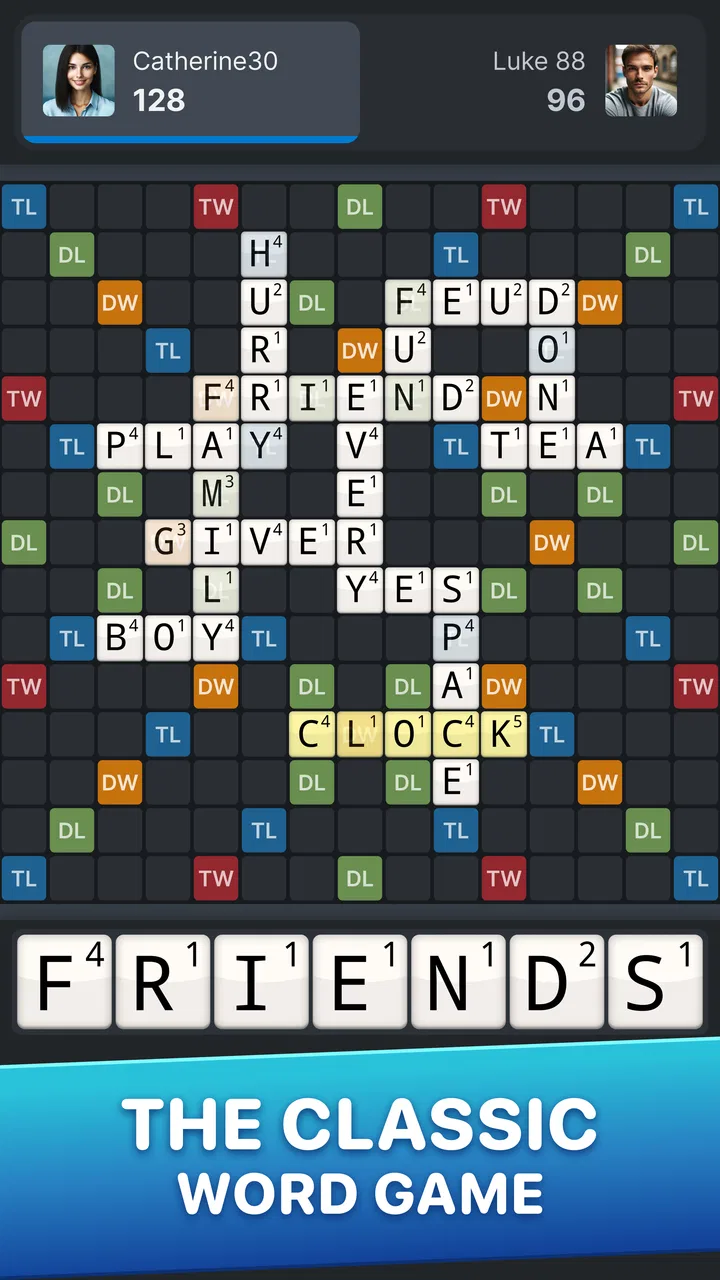
I came back to Wordfeud because it solves a very specific problem well: it gives word-game fans a reason to play slowly and thoughtfully with another person. This is a multiplayer word game from Bertheussen IT, built around making valuable words rather than racing through a timed puzzle. I found it easy to understand at first, but its real appeal appears after several turns, when the board becomes a small strategy problem involving letter placement, future openings, and the other player’s habits.
It is free to start, rated for Everyone, and has been available since 2010. Its long presence is reflected in a 4.5 average from around 659 thousand ratings, while more than 10 million installs show that it has reached well beyond the usual circle of serious word-game players. That popularity matters here because a turn-based multiplayer game is much more enjoyable when finding an opponent is not the main challenge.
How the board feels to read and navigate
The first thing I noticed was that the game asks me to focus on a compact board rather than a busy stream of menus. That is a good fit for anyone who prefers a clear, contained task. I can look at the letters available to me, inspect the spaces already occupied, and decide whether to play immediately or spend time searching for a stronger arrangement. The basic loop is understandable without a long tutorial: make a word, place it, and wait for the other player.
You May Also Like

 Pandora - Music & Podcasts
Pandora’s Music Is Easy to Start, but Harder to Recover
Pandora’s strength is its low-effort path from a seed to a station. Its weak spot is how much confidence it asks you to place in connection, setup, and quiet recovery.

 8 Ball Pool
 Is Built on Rivalries, Rematches, and Routine
A close look at the rivalries, rematches, shared routines, and unanswered safety questions that turn a quick pool match into a persistent mobile community.

 Samsung Music
’s Quiet Strength Is Playing What You Already Own
Its reach comes less from spectacle than from dependable access to a personal library. That simplicity is both the app’s strongest retention engine and its ceiling.

 AccuWeather: Weather Radar
AccuWeather Review: A Quick, Clear Forecast for Everyday Decisions
For everyday plans, the best forecast is the one you can understand quickly. AccuWeather makes rain timing, radar, and local conditions easy to act on, with a few trade-offs.

 Hill Climb Racing
Why Hill Climb Racing Still Turns Crashes Into One More Run
A tiny car, a bumpy hill and one more upgrade: Hill Climb Racing keeps resurfacing because its simple chaos makes every near-miss feel personal.

 AliExpress - Shopping App
AliExpress Makes Global Shopping Feel Personal, but Shoppers Bear the Risk
AliExpress turns a global marketplace into a pocket-sized discovery engine. Its reach is useful, its shopping loop compelling, and its trade-offs easy to miss.
More From Our News Desk
View All News


That simplicity also makes the game approachable for people who do not enjoy complicated interfaces. A player who is comfortable with ordinary word puzzles can usually understand the purpose of each turn quickly. The challenge comes from vocabulary and planning, not from learning a large set of controls. In my experience, this makes it suitable for a quiet first session with a friend or family member who is less confident with mobile games.
Readability becomes more personal once a match develops. The board contains a lot of information in a small space: existing words, open squares, valuable positions, and the letters on my rack. On a small phone, I sometimes had to slow down and inspect the arrangement instead of grasping it at a glance. That is not a deal-breaker, but it means the experience is better when I am not trying to play while walking, rushing between tasks, or dealing with glare.
I also appreciate that the turn-based structure gives me permission to navigate carefully. I do not need to make a decision in a few seconds, so I can rotate the phone, enlarge my attention on one area, or return to the board after a short break. For players with slower reading speed, attention differences, or a preference for deliberate choices, that pause is more valuable than a flashy interface would be.
There is a useful distinction between understanding the controls and understanding the strategy. The controls are approachable, but the game does not remove the mental work of checking whether a word is worthwhile. I have had turns where I found a valid-looking word but missed a better placement because I concentrated on the word itself rather than the board. That learning curve is satisfying for experienced players, though newcomers may need several matches before the layout feels natural.
Why the turn structure helps different players
A major strength is that a match does not demand continuous attention. I can take a turn, close the game, and return later. This makes it easier to fit into a day shaped by work, study, childcare, commuting, or medical appointments. It also reduces the pressure that often excludes people from fast mobile games. Someone who needs extra time to read, plan, or physically position a move can participate without being punished by a countdown.
The same design supports social play across different routines. A friend who checks a phone frequently can respond quickly, while another player may need much longer. The match can continue without either person having to schedule a shared block of free time. I found this especially useful for keeping a low-pressure game going with someone who lives elsewhere, because the conversation and competition do not depend on being online together at one exact moment.
There is a trade-off, though. If I want immediate action, this can feel slow. The game’s pleasure comes from anticipation, not constant stimulation. Players who prefer rapid rounds, animated reactions, or an obvious single-player progression may find the waiting between turns less engaging than a conventional puzzle app.
Motor, sensory, and cognitive considerations
From a motor perspective, a word board is less demanding than a game built around rapid tapping, swipes, or precise timing. I can think before acting, and a turn does not require a chain of fast gestures. That makes it a reasonable option for players who find action games tiring or difficult to control. It can also be more comfortable for someone using a phone with one hand, provided the board and letter area are easy for that person to reach.
Still, placing a word accurately requires attention to individual squares. Players with limited fine-motor control may find small targets uncomfortable, especially on a compact screen. I would recommend using the largest comfortable display available and avoiding rushed play. The game’s slow pace helps, but it does not eliminate the physical need to select and arrange letters.
For sensory needs, the restrained nature of a word game can be an advantage. There is no need to follow a moving character or monitor a crowded action scene. The core information is visual and relatively stable. That can make it easier to play in a calm environment or during a short rest period when a more intense game would be overwhelming.
On the other hand, visual access remains central. The board, letters, and scoring information all need to be distinguished. Players with low vision, color-vision differences, or difficulty reading small text should test the game on their own device before committing to long matches. I would not treat the uncluttered concept as proof that every visual need is covered. A simple board can still be demanding if its squares or text are hard to distinguish.
Players who rely on audio rather than visual information may also find the experience limiting, because the essential state of a match is represented on the board. The game is quiet by nature, which is pleasant for some people, but quietness is not the same as comprehensive nonvisual support. Anyone who needs spoken feedback for letter positions or move confirmation should approach it cautiously.
Cognitively, the game offers both an accessible entry point and a deep ceiling. I can play casually by looking for a sensible word, or I can spend much longer considering how a move changes the board. The latter introduces several layers of thought: protecting useful squares, avoiding an easy scoring opportunity for the opponent, saving flexible letters, and deciding whether a modest move is safer than a spectacular one.
One practical tip improved my play: I stopped treating every turn as a search for the longest word. A shorter word can be better if it blocks a profitable area or keeps useful letters for the next turn. This is one of the game’s less obvious lessons, and it also helps new players avoid feeling that they have failed whenever they cannot produce something impressive.
Useful habits for a more comfortable match
I found three habits particularly helpful. First, I review the whole board before arranging letters, rather than staring only at the rack. This reduces the chance of overlooking a safe placement. Second, I take a moment after finding a possible word to compare its position with at least one alternative. The first acceptable move is not always the best one. Third, I play in short, intentional sessions instead of repeatedly checking for an opponent’s turn. That protects the relaxed quality that makes the format enjoyable.
Another useful approach is agreeing on expectations with the person I am playing. Some opponents answer quickly; others treat a match as an occasional activity. Because the game is multiplayer and turn-based, the social rhythm can matter as much as the board. A player who dislikes waiting should choose an opponent with a similar routine, while someone looking for a gentle long-distance connection may enjoy a slower match.
The game can also work well as a shared activity between generations. An experienced player may have a stronger vocabulary, but a newcomer can still learn by observing how board position affects a move. I would avoid presenting it as a test of intelligence. The better framing is that it rewards different strengths: vocabulary, patience, spatial awareness, risk management, and the ability to notice opportunities others miss.
Using it in real situations
My favorite everyday use is a match that runs alongside a busy week. I might play a turn during a lunch break, leave the phone alone through an afternoon meeting, and return in the evening. The match remains a small mental reset rather than another obligation demanding constant replies. This is a much better fit for fragmented time than a game that loses progress when I cannot stay focused.
It is also a good choice for a quiet social connection. Two people can maintain a friendly competition without needing to exchange long messages or arrange a video call. The board gives the interaction a clear subject, and a move can communicate personality: cautious, inventive, defensive, or deliberately bold. For someone who finds open-ended social apps tiring, that structure may make contact feel easier.
Travel is another situation where the format makes sense. A turn-based match can occupy a waiting period without requiring the commitment of completing a whole level. However, I would not assume that every part of a journey will be equally comfortable. Glare, a moving vehicle, poor battery conditions, or unreliable connectivity can make a visually focused board less pleasant. The game is flexible about time, but the physical environment still affects access.
For a classroom, club, or family setting, it can provide a friendly word challenge, but the competitive element needs handling thoughtfully. Players with different vocabulary backgrounds may have very different experiences. I would encourage house rules about patience and respectful play rather than treating every unusual word as a chance to embarrass someone. The game is most inclusive when the goal is shared enjoyment, not proving who has the largest vocabulary.
It is worth considering the economic side as well. The game is free to download, with in-app purchases priced at $6.49 per item. That gives curious players a low-risk way to try the format, while people who prefer a completely purchase-free experience should pay attention to how optional spending fits their own habits. I would not choose a game solely because its entry price is low; the more important question is whether its slow multiplayer rhythm suits the way I actually use my phone.
Where the experience still creates barriers
The biggest barrier is not complexity but dependence on a particular kind of attention. I need to read the board, recognize letters, compare positions, and tolerate uncertainty while waiting for the other player. Someone looking for a game that can be enjoyed almost automatically may not find much comfort here. Even a casual match asks for more concentration than a simple tap-to-score pastime.
Vocabulary can become a social barrier too. Players who use English as an additional language, who have dyslexia, or who simply do not enjoy spelling contests may feel exposed when matched with a highly experienced opponent. The game can support learning through practice, but it does not automatically make differences in language background disappear. Choosing a patient friend is often more important than choosing the perfect strategy.
The board can also become visually dense as words accumulate. I sometimes needed to pause before understanding which spaces were still strategically open. That is manageable for me, but it may be tiring for players with visual processing difficulties or limited working memory. A slower turn helps, yet it can also invite overthinking and fatigue if every move becomes an extended search.
There is a practical barrier for people who need strong, explicit accessibility controls. I would not recommend assuming that a word-game layout automatically supports screen magnification, screen readers, alternative input methods, or every preferred contrast setting. Anyone depending on those tools should try the app directly on the intended phone and operating system before starting a serious match. The safest recommendation is based on personal testing, not on the category alone.
Players who want a rich solo experience should also think carefully before choosing it. Its identity is tied to playing against another person, so someone who wants a large collection of offline puzzles, a story, or a guided training campaign may be better served by a dedicated solo word app. Likewise, a person who dislikes asynchronous play may prefer a faster alternative that puts both participants in the same session.
Compared with a paper word board, this version is more convenient for playing at a distance and keeping a match going through interruptions. Compared with a quick daily word puzzle, it offers more social strategy but less instant closure. Compared with a fast competitive word game, it is gentler on reaction time but less exciting for players who need constant momentum. Those differences are more useful than simply calling it fun: they explain when it belongs on my phone.
My inclusive verdict
I recommend Wordfeud to people who want a thoughtful multiplayer word game that respects uneven schedules. Its strongest accessibility quality is the turn-based pace: I can read, plan, and act without racing a clock. The compact board keeps the purpose clear, and the strategic depth gives experienced players something to return to after the novelty of making simple words has faded.
I would recommend it especially to friends and relatives who want a low-pressure activity across distance, to players who prefer planning over reflexes, and to anyone who enjoys seeing how a small board changes after every decision. It can be a surprisingly good bridge between casual play and serious competition because the same move can be judged at a relaxed or highly strategic level.
I would hesitate to recommend it to someone who needs a strongly visual-free experience, finds small board targets difficult, or wants a complete solo package. I would also warn impatient players that the waiting is not a minor detail; it is part of the design. The game is not trying to be a rapid arcade challenge, and it loses much of its charm when I treat every turn as something that must be rushed.
Overall, Bertheussen IT has made a durable word game whose inclusive potential comes from patience rather than spectacle. It does not remove every visual, motor, language, or cognitive barrier, so individual testing still matters. For me, though, the combination of a readable central task, flexible timing, and meaningful board decisions makes it one of the better choices for social word play when I want competition that can fit around real life.
FAQs for Wordfeud
01What is Wordfeud and how does it work?
Wordfeud is a popular multiplayer word game that challenges players to create words on a Scrabble-like board. Each player takes turns placing tiles to form words, earning points based on the letter values and board placement. The game can be played against friends or random opponents, making it both competitive and social.
02Is Wordfeud free to play, and are there in-app purchases?
Wordfeud is free to download and play, offering a range of features without cost. However, there are in-app purchases available, such as an ad-free experience. While ads do not impact gameplay, removing them can enhance the user experience for those who prefer uninterrupted play.
03Can I play Wordfeud offline or is an internet connection required?
Wordfeud requires an internet connection to play since it is a multiplayer game. The online connectivity allows for real-time gameplay against opponents and ensures that moves are synchronized across devices. Unfortunately, there is no offline mode available at this time.
04What are the main features that make Wordfeud stand out?
Wordfeud offers several features that make it appealing, including a customizable board, multiple language options, and a straightforward interface. The game supports cross-platform play between Android and iOS users, allowing a wider range of opponents. Its random opponent feature also ensures a fresh and challenging experience every time.
05How does Wordfeud handle cheating and fair play?
Wordfeud employs various measures to ensure fair play, including monitoring for suspicious activity and providing tools for players to report any cheating. The community-driven reporting system helps maintain a competitive and fair gaming environment, making it enjoyable for all users.
Pros
- Engaging multiplayer gameplay.
- Customizable board settings.
- Supports multiple languages.
- Non-intrusive ads.
- Easy to navigate interface.
Cons
- Limited offline features.
- Occasional lag in gameplay.
- In-app purchases can be costly.
- Notifications can be inconsistent.
- Requires stable internet connection.

Wordfeud
Gallery